Polish Meadow Biodiversity: Context
Poland sits at a biogeographic crossroads between Atlantic, continental and steppe influences, which gives its grassland flora a notable breadth. Traditional hay meadows — maintained through annual cutting and the absence of fertiliser over generations — can support upwards of 40 vascular plant species per square metre in the best-preserved sites.
Much of this diversity has contracted sharply since the mid-twentieth century due to intensification, abandonment and conversion. However, the floristic template remains accessible: many species persist in roadside verges, field margins, nature reserves and unimproved pastures across the country.
The species below represent a cross-section of the flora associated with lowland and foothill meadow habitats. Distribution and ecological notes draw on publicly available data from the Global Biodiversity Information Facility and published flora of Poland.
Annual Species
Annuals are prominent in the first one to three years of a new meadow and in any area of disturbed or freshly exposed soil. They rely on soil seed banks or fresh seed to reappear each year and gradually give way to perennials as competition increases.
Cornflower — Centaurea cyanus
One of the most recognisable arable-field plants in Poland, the cornflower was historically common across central and eastern lowlands wherever winter cereals were grown. It is a cool-season annual, germinating in autumn or early spring, and flowers from May to August depending on sowing time. The intense blue of the ray florets makes it visible from a distance.
Cornflower requires disturbed, nutrient-poor, well-drained ground and does not persist in dense perennial sward. On suitable sites, it self-seeds readily for three to five years after initial sowing. Its conservation status in Poland has declined with modern herbicide use; it is no longer common as a true arable weed in many regions.

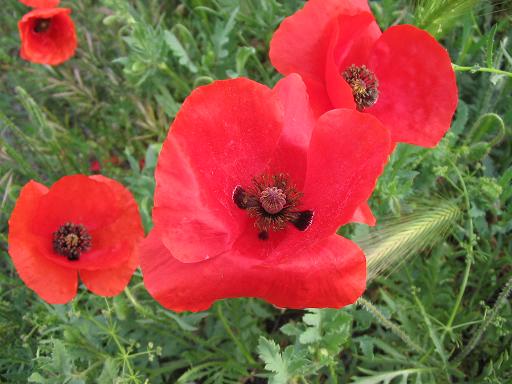
Common Poppy — Papaver rhoeas
The common poppy accumulates a persistent seed bank in disturbed soils. Seeds remain viable for many years and germinate when brought to the surface by cultivation. It flowers from June to July and produces hundreds of seeds per plant. The papery scarlet flowers last only a day or two individually, but successive bud development extends the display over several weeks.
In a managed meadow, poppy is most prominent in the first season after soil disturbance and fades in subsequent years unless the soil is partially re-disturbed annually. It is particularly associated with calcareous and chalk soils in southern and south-eastern Poland.
Chamomile — Matricaria chamomilla
Chamomile is an aromatic annual characteristic of light, neutral to slightly acid soils. It is common on sandy lowland soils across central Poland, less so on the heavier clays of the south-east. Flowers appear from May to August; the daisy-like heads have white ray florets and a yellow disc that becomes markedly hollow and cone-shaped at maturity.
It is shorter in stature than oxeye daisy and tends to form dense patches where soil conditions suit it. In a meadow context it is a good early-year coloniser on light soils but may be outcompeted by perennials after the second or third season.

Perennial Species
Perennials give the meadow its long-term structure. They establish slowly in the first one to two years but persist and spread once rooted, providing the framework around which shorter-lived species cycle.
Oxeye Daisy — Leucanthemum vulgare
Among the most adaptable of Polish meadow plants, the oxeye daisy is found across a wide range of soil types and moisture levels. It flowers from May to August and is one of the first perennials to produce visible flowering plants in a newly sown meadow — sometimes in year one from an autumn sowing. Spreading by both seed and short rhizome, it forms persistent clumps that are characteristic of semi-natural grassland across Poland.
The species is recorded across all Polish voivodships and is well suited to inclusion in regional seed mixes without ecological concern.

Yarrow — Achillea millefolium
Yarrow is a creeping rhizomatous perennial with finely divided, feathery leaves and flat-topped corymbs of small white or pale pink flowers from June to September. It grows on poor, well-drained soils and tolerates dry conditions well — important on the sandy soils of central Poland where summer moisture deficits are common.
It spreads slowly but persistently by underground rhizome, forming irregular patches that help suppress coarser grass. In established meadows it is a structural constant, persisting through dry years when other species fail to flower.
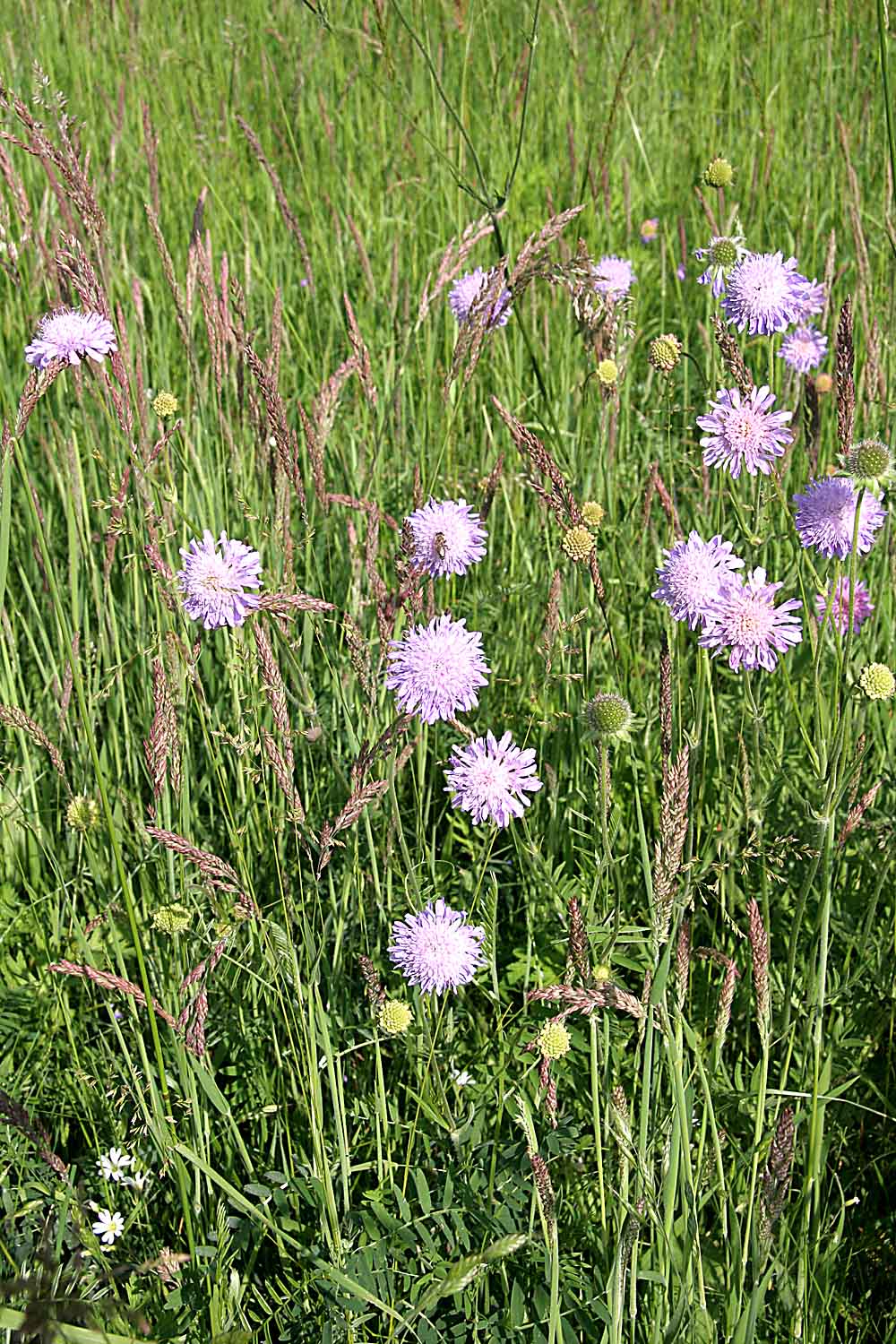
Field Scabious — Knautia arvensis
Field scabious is a tall, branching perennial flowering from July to September — extending the season beyond many earlier species. The lilac-pink, pincushion flower heads are attractive to a range of late-season insects. It grows on dry to moderately moist, well-drained soils and is most prevalent on calcareous ground in southern and central Poland, though it occurs across the lowlands on neutral soils.
Establishment from seed is slower than oxeye daisy or yarrow, with flowering plants typically appearing in year two or three. Once established, plants are long-lived and self-seed moderately on suitable ground.
Self-Heal — Prunella vulgaris
A low-growing, mat-forming perennial common in unimproved grassland across Poland. Self-heal tolerates moderate grazing and trampling, making it persistent in meadows with occasional foot traffic. It flowers from June to September; the violet-purple flower spikes are short but numerous on established plants.
It grows on a wide range of soils, tolerates partial shade at the margins of meadow areas, and is genuinely ubiquitous in Polish grassland from sea level to the mountain foothills. Its modest stature means it sits beneath taller species without competing aggressively.

Regional Variation
Polish meadow flora shifts noticeably across the country's main geographic zones:
| Region | Soil tendency | Characteristic species |
|---|---|---|
| Baltic coastal lowlands | Sandy, acid | Matricaria chamomilla, Achillea millefolium, Anthoxanthum odoratum |
| Central Mazowsze plains | Sandy loam, neutral | Centaurea cyanus, Papaver rhoeas, Leucanthemum vulgare |
| Lublin Upland and Malopolska | Loess, neutral to alkaline | Knautia arvensis, Centaurea scabiosa, Salvia pratensis |
| Sub-Carpathian foothills | Clay-loam, moderately moist | Geranium pratense, Filipendula vulgaris, Sanguisorba officinalis |
Seed sourcing that reflects these regional differences produces more stable results than generic commercial mixes. Where possible, sourcing seed from suppliers with documented provenance from Poland or adjacent regions is preferable to materials of unknown or Mediterranean origin.
Protected Species Notes
Some species associated with Polish meadow habitats have formal protection status under Polish law or are listed on the regional Red Lists. Before collecting seed from wild populations, verify the legal status of the species and location under the Act on the Protection of Nature (Ustawa o ochronie przyrody). Commercially available seed of the species listed in this article is generally legal to purchase and sow. Wild collection without permission is a separate matter.